
Until recently the question was «what should I ask the AI?». Now it is a different one: «what should I let it do?». A chatbot answers; an agent decides what comes next and executes it with real tools: it opens a ticket, writes to the ERP, sends an email to a customer. The leap is not about capability, it is about accountability.
An agent uses a model to decide steps and tools within limits. And to act it needs three things that are almost never defined before the pilot: least-privilege permissions, verification and a named owner. Without those three there is no production-ready autonomy; there is an experiment wired to real data. That is why we condensed into a single sheet the eight decisions worth settling before you let an agent act.
Chatbot, copilot, workflow or agent: they are not the same
The word «agent» is being used for four different things, and each one carries a distinct risk:
- Chatbot: it answers. The risk is a wrong answer.
- Copilot: it proposes and you decide. The decision stays human.
- Workflow or RPA: it follows fixed rules. Predictable, and it breaks on exceptions.
- Agent: it decides what comes next. Here the risk is no longer the answer, it is the action.
The comparison is indicative and hybrids are possible. What matters is knowing where you stand, because that is what determines the controls you need.
The operating loop: where pilots fall down
A well-built agent always repeats the same cycle: goal, observe, decide, act, verify, log and close, with an error-or-escalate exit available at any point. Almost every pilot implements «observe, decide, act» and skips «verify» and «log». That is exactly backwards: without verification you do not know whether the outcome is correct, and without a log you cannot audit, explain or roll back what the agent did. That is the part that turns a demo into a system you can defend in front of management, a client and an auditor.
The 8 decisions before production
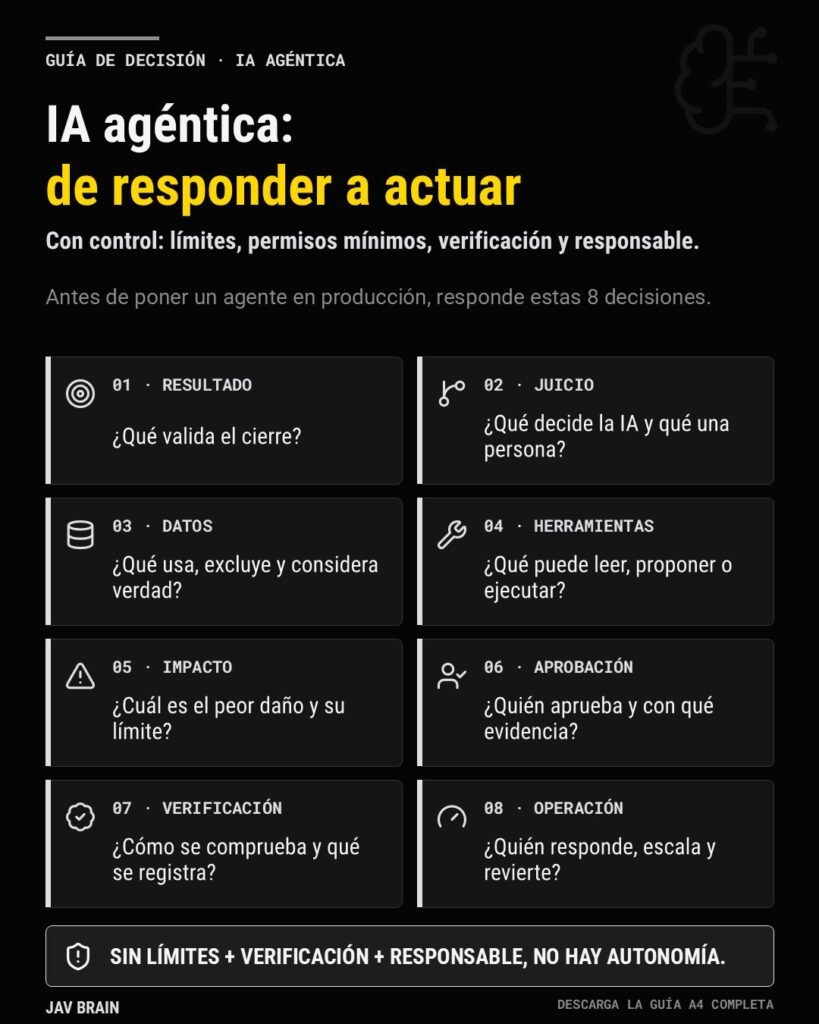
None of these eight questions is technical: they are all business questions, and they should all have a written answer before the first line of code.
- 01 · Outcome: what result validates completion? If you cannot describe what «done well» looks like, you will not be able to verify or measure it.
- 02 · Delegated judgement: what does the AI decide and what does a person decide? Write it as a boundary, not as an intention.
- 03 · Data: what data does it use, what does it exclude, and which source wins when two systems disagree?
- 04 · Tools: what can it read, propose or execute? Least privilege per tool, not one account with access to everything.
- 05 · Impact: what is the worst possible harm and which limit contains it? Maximum amount, number of sends, time window, environment.
- 06 · Approval: who approves, and with what evidence in front of them? Approving without seeing the evidence is signing a blank cheque.
- 07 · Verification: how is the outcome checked and what is logged at every step?
- 08 · Operation: who responds when it fails, who does it escalate to, and how is it rolled back?
Eight questions, eight answers. If any of them is left as «we will see», that is your next incident.
Agent or automation?
Not every process needs an agent, and building one where a rule would have done is the most expensive way to automate. An agent fits when cases vary and depend on context, several tools are involved and exceptions require judgement. An automation fits when the sequence is stable, the rules are explicit and there are few exceptions. Our criterion is simple: if a rule is enough, we automate; if it demands context and judgement, we consider an agent. It is the approach behind our AI agents and automation service, and the natural continuation of the agentic company: how to govern your AI agents.
Autonomy is granted per action, not per agent
«How much autonomy do we give it?» is the wrong question. Autonomy is not granted to the agent, it is granted to each action: observe (read only), prepare (leave the action ready for a person to confirm), execute (act within explicit limits) and block (stop and escalate). With a routing rule that resolves the normal case on its own: below the threshold, execute; outside policy, escalate. That way routine volume flows and the exception reaches a person with the context in front of them, not as one more alert.
What to measure from day one
An agent in production without metrics is an opinion. Six indicators are enough: correct outcome, appropriate escalation, error and rollback, cycle time, cost per outcome (not per token, per case resolved) and incidents and traces. They are the same ones we watch once AI is already working inside the team’s tools, as we covered in AI works inside the tools you already use.
The decision guide on a single sheet
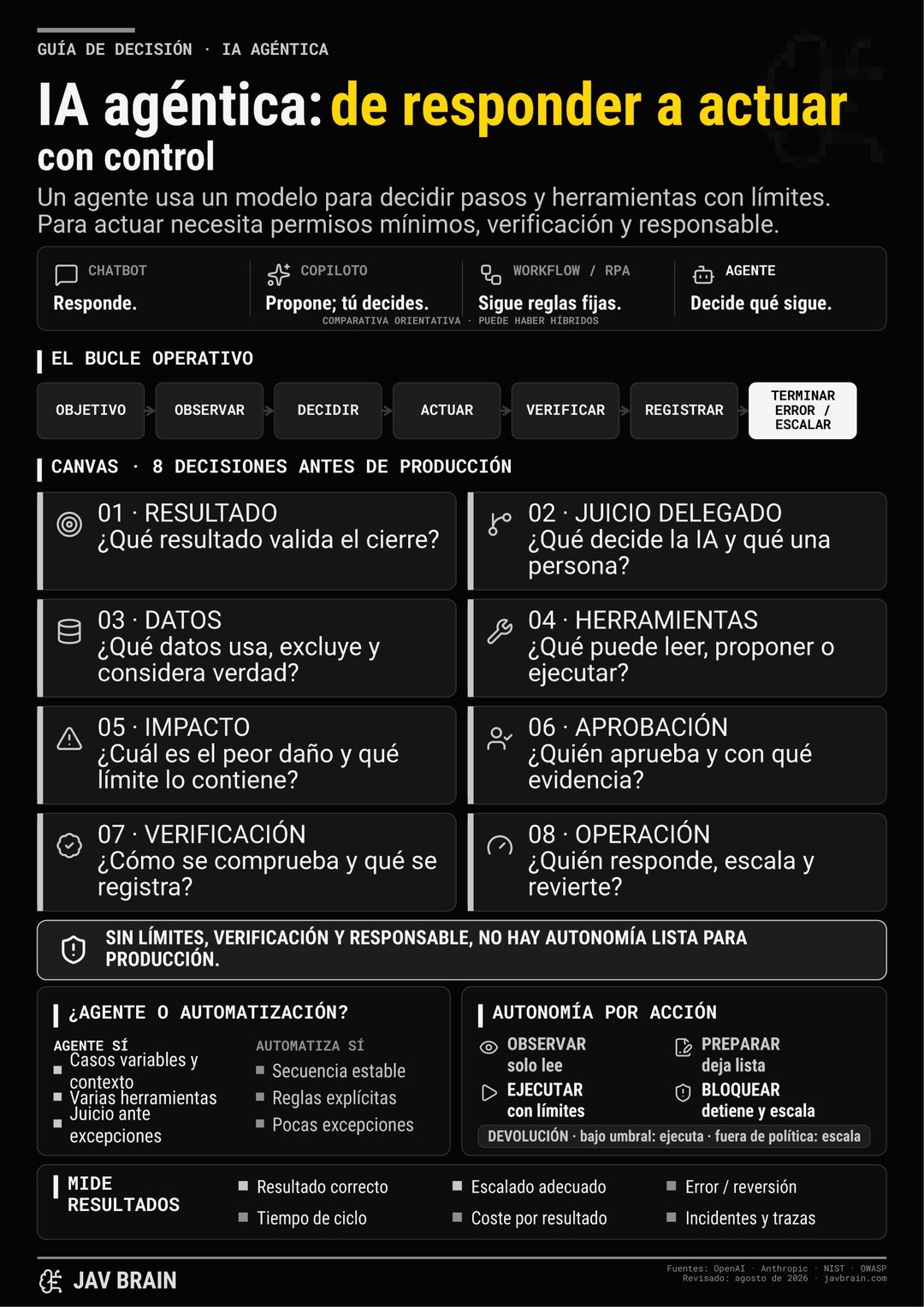
You can download the full guide as a PDF (A4, one sheet) and use it as a checklist in your next meeting. It is built on OpenAI’s practical guide to building agents, Anthropic’s research on trustworthy agents, NIST’s agent-hijacking evaluations and the OWASP Top 10 for Agentic Applications 2026.
The question that decides it: which of the eight is still unresolved at your company today? Book a free meeting and we will review one concrete process to decide the next step.