

Mistral Large 4 is currently the most intelligent model outside the US and China, scoring 38.4 on the Artificial Analysis index, but it is still a preview release and being European does not guarantee your data stays in Europe. We reviewed the independent data from Artificial Analysis and Vals AI as of 8 October 2026 to answer three questions: how well it performs, where it is processed and how to test it before you decide. Figures may move while Large 4 remains in preview.
This article covers the analysis in our LinkedIn carousel. If you are evaluating models for your company, it pairs well with the 8 decisions before you let an agent act.
How much has Mistral Large 4 improved?
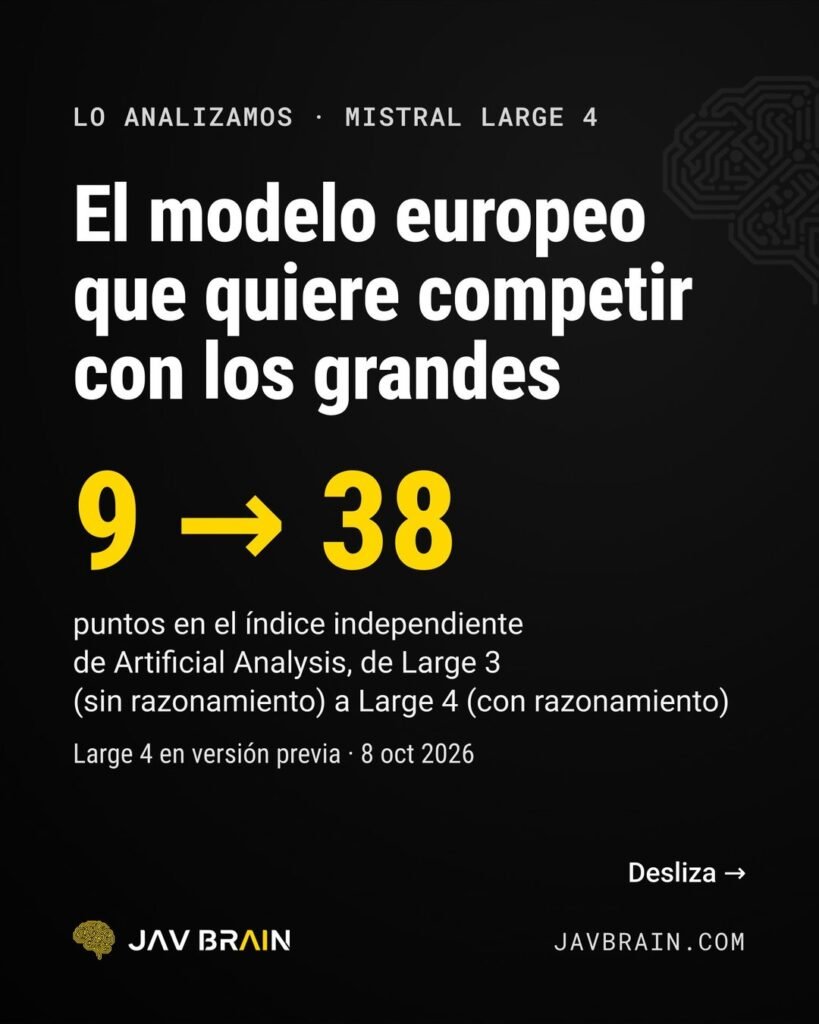
According to Artificial Analysis, the jump is from 9 to 38 points on its independent index, from Large 3 (no reasoning) to Large 4 (with reasoning). Read the figure carefully: it compares a non-reasoning model with one that reasons, and Large 4 is in preview.
Is it the best model outside the US and China?
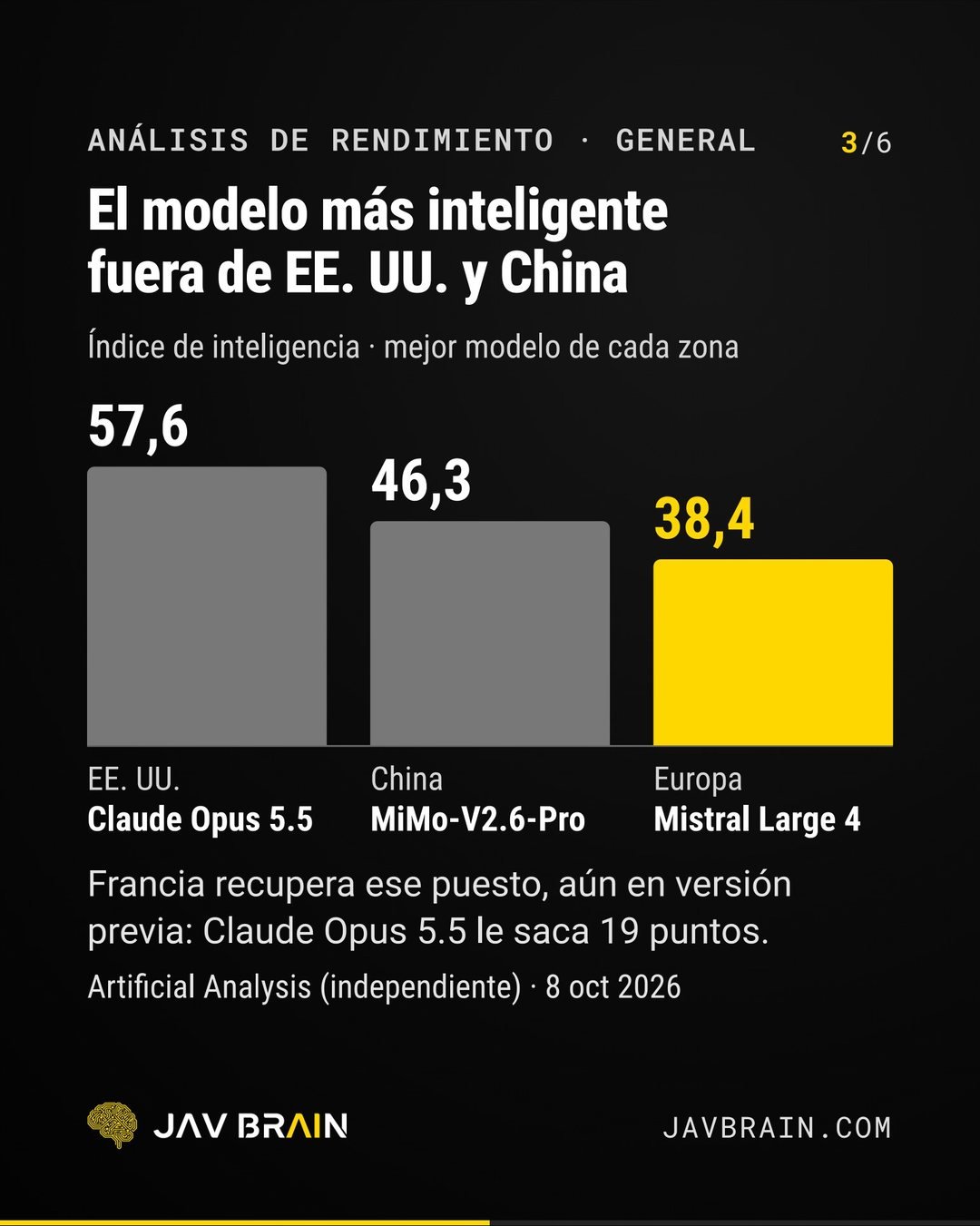
Yes, according to the Artificial Analysis intelligence index, which compares the best model from each region:
- US: Claude Opus 5.5, 57.6 points.
- China: MiMo-V2.6-Pro, 46.3 points.
- Europe: Mistral Large 4, 38.4 points.
France thus takes back that spot, still in preview. The gap is real: Claude Opus 5.5 is 19 points ahead.
Does it perform well on legal tasks?
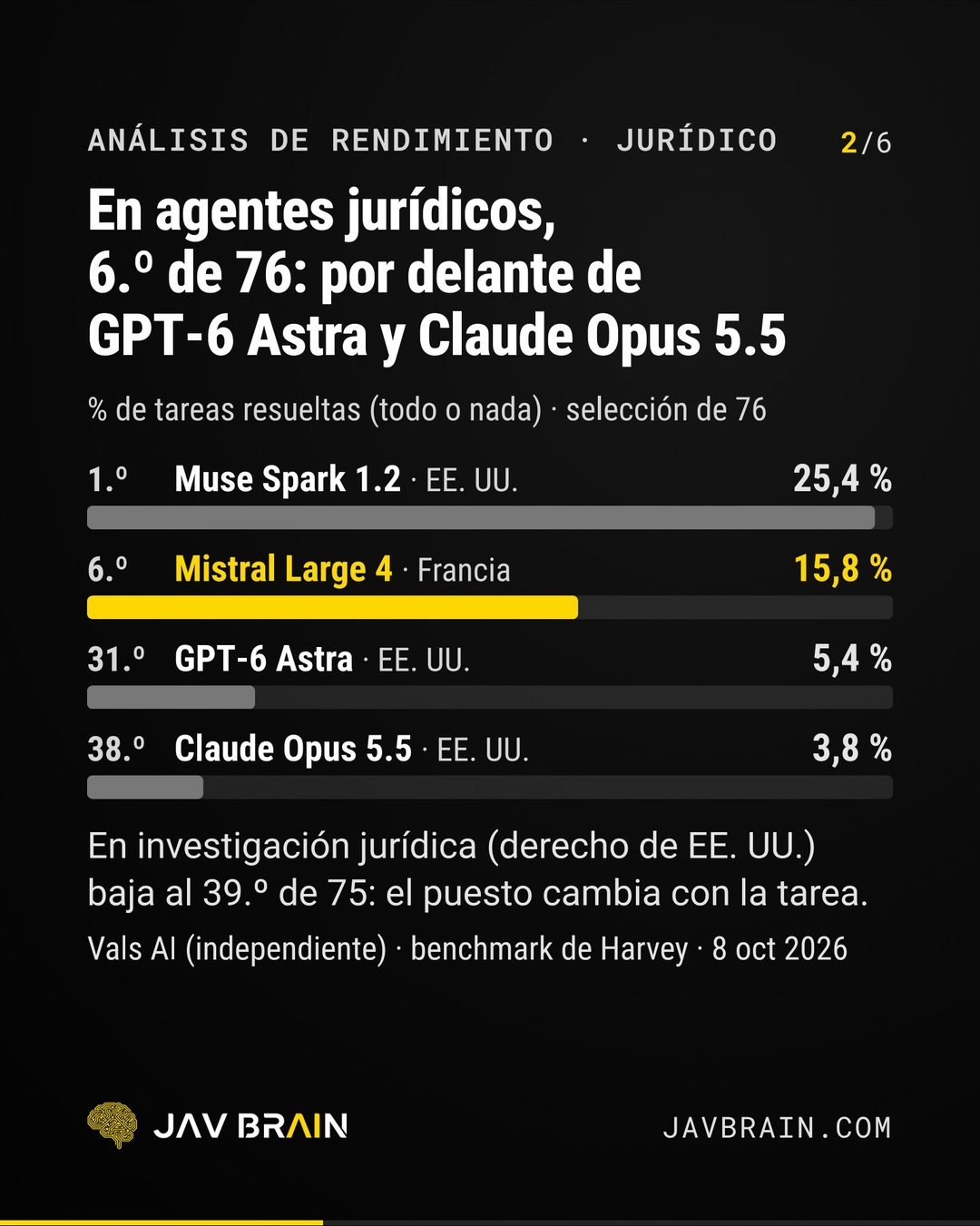
It depends on the task. On Harvey’s legal agent benchmark, measured by Vals AI (independent), Mistral Large 4 ranks 6th of 76 selected models, solving 15.8% of tasks (all or nothing):
- 1st Muse Spark 1.2 (US): 25.4%.
- 6th Mistral Large 4 (France): 15.8%.
- 31st GPT-6 Astra (US): 5.4%.
- 38th Claude Opus 5.5 (US): 3.8%.
But in legal research (US law) it drops to 39th of 75. The ranking changes with the task, so a general leaderboard is no substitute for testing it on your own cases.
Where is your data processed with Mistral Large 4?
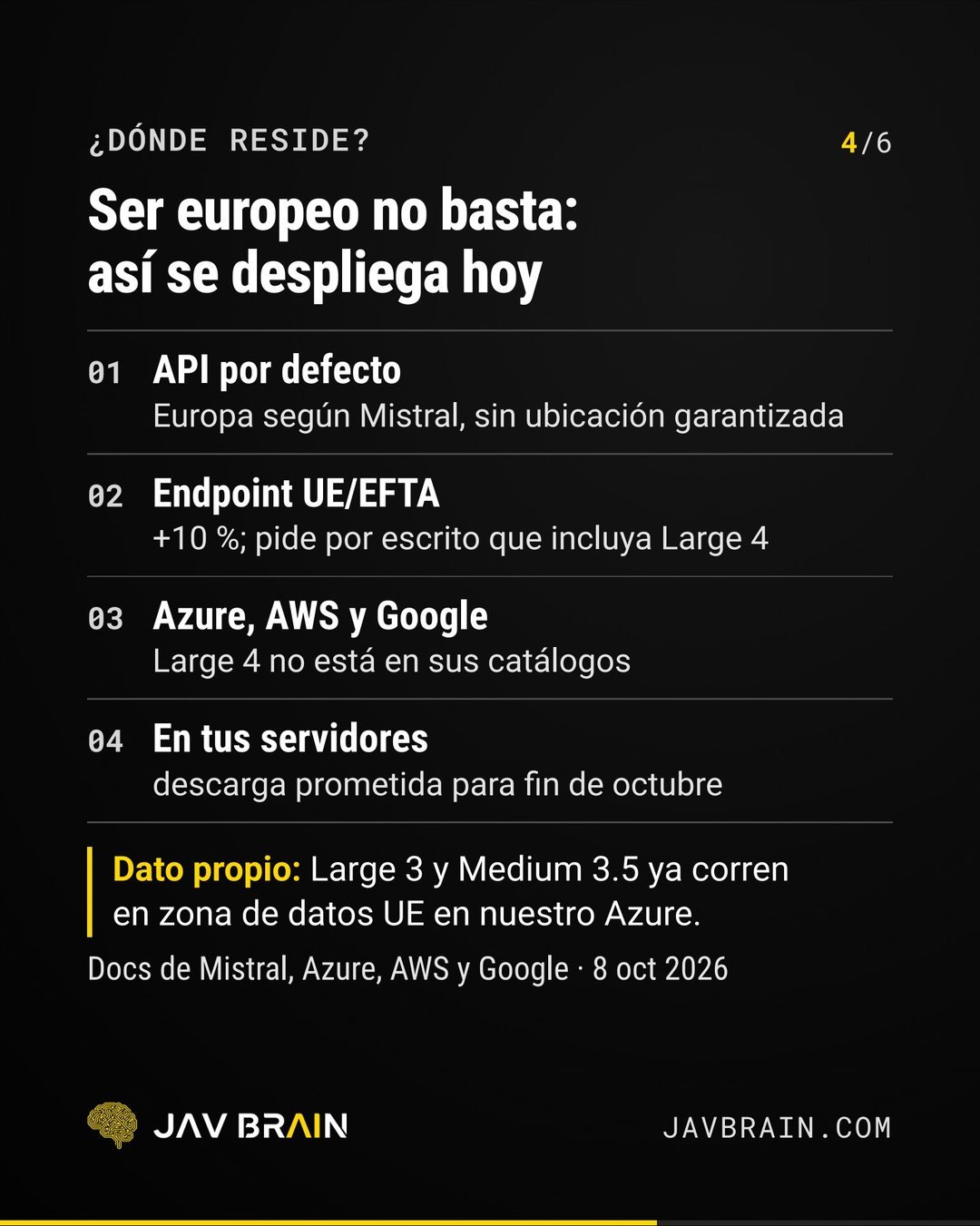
Being European is not enough. This is how it can be deployed today, according to the documentation from Mistral, Azure, AWS and Google:
- Default API: Europe according to Mistral, with no guaranteed location.
- EU/EFTA endpoint: 10% more expensive; ask in writing that it includes Large 4.
- Azure, AWS and Google: Large 4 is not in their catalogs.
- On your own servers: download promised for the end of October.
From our own experience, at JAV BRAIN we already run Large 3 and Medium 3.5 in an EU data zone on our Azure.
Which four checks should you run before using it?
The carousel suggests asking your team, on Monday, for four checks (JAV BRAIN’s own criteria, with Article 28 of the GDPR as the contractual reference):
- 20 real cases, and 3 that the model must refuse to answer.
- Pass mark set beforehand: 18 out of 20, and measure your current model too.
- In writing: where it is processed, whether it trains on your data, and the Article 28 GDPR contract.
- Account and invoicing: whether they sit outside the EU, and what data travels with them.
With 20 cases you rule options out, you don’t pick one. And the method works for the next model too.

Which task in your company would you test first with a European model?
European companies now have one more option to try. Our closing question: invoices, contracts, customer service or something else. Tell us.
Related. If European data residency is your deciding criterion, this is how we handle it in the governance layer described in what we put on top of Microsoft.
Frequently asked questions
What score does Mistral Large 4 get on Artificial Analysis?
38.4 points on the intelligence index, the highest for a European model on that index. Claude Opus 5.5 (US) scores 57.6 and MiMo-V2.6-Pro (China) 46.3. Large 4 is in preview, so figures may move.
Does Mistral Large 4 guarantee my data stays in the EU?
Not by default. The default API is “Europe according to Mistral, with no guaranteed location”. There is an EU/EFTA endpoint with a 10% surcharge; ask in writing that it includes Large 4. Azure, AWS and Google do not list it in their catalogs.
How do I decide whether a European model suits me?
With your own test: 20 real cases (3 of which it must refuse), a pass mark fixed beforehand at 18 out of 20, and the same test on your current model. With 20 cases you rule options out, you don’t pick one.
Evaluating models for your company? We help you build that test and decide where your data is processed, through our AI consulting service. Book a free exploratory session and we will review your case together.
More analysis like this in the original LinkedIn post.